In the cargo industry, the choice of materials for trailer skin and side panels directly impacts transportation efficiency, cost structure, and service life. As a professional trailer aluminum sheet manufacturer, we deeply understand the unique advantages of aluminum in this field. Aluminum sheets are an ideal material for cargo trailer skin and side panels due to their numerous advantages in performance, economy, and environmental friendliness.
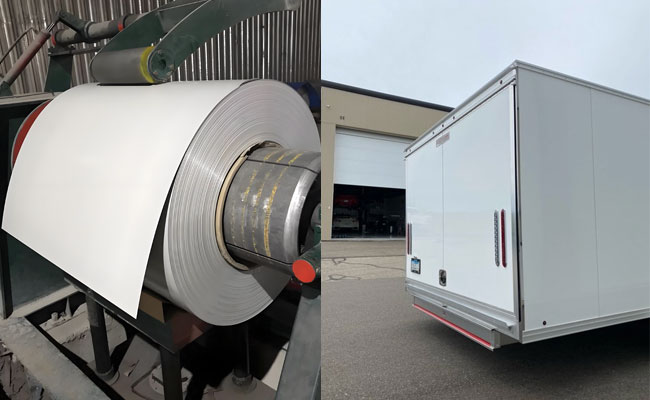
Firstly, aluminum is renowned for its excellent strength-to-weight ratio. Compared to traditional steel, aluminum alloys are lighter for the same strength. This characteristic allows for a reduction in the overall weight of the cargo trailer, thereby improving transportation efficiency and reducing fuel consumption. In long-haul transportation, lightweighting not only reduces transportation costs but also increases vehicle capacity and improves overall operational efficiency. For example, 3003 aluminum-manganese-magnesium alloy has a density of only 2.73 g/cm³, 65% lower than traditional carbon steel (7.85 g/cm³). According to data from the Technical University of Graz (TU-Graz) in Austria, for every ton of weight reduction in a trailer truck, 0.6 liters of fuel can be saved per 100 kilometers. Replacing the trailer shell and side panels entirely with 3mm thick 3003-H14 temper aluminum sheets (8kg/m²), a single trailer can be reduced in weight by approximately 400kg, resulting in annual fuel savings of 2400 liters when operating for 100,000 kilometers per year.
Secondly, aluminum exhibits extremely high corrosion resistance. The naturally formed oxide film on the aluminum surface makes it perform exceptionally well in harsh environments such as humidity and salt spray, effectively resisting oxidation and corrosion. In cargo scenarios, trailer aluminum sheets are exposed to corrosive environments such as ultraviolet radiation, acid rain, and salt spray for extended periods. We employ a fluorocarbon pre-roll coating process (PVDF coating), whose C-F bond energy in its molecular structure reaches as high as 485kJ/mol, effectively resisting ultraviolet degradation. Experimental data shows that after 2000 hours of salt spray testing (ASTM B117 standard), the coating adhesion still maintains a 5B grade (the highest grade), and the surface gloss loss rate is less than 5%. Furthermore, the naturally formed alumina film (approximately 2-5 μm thick) on the surface of aluminum sheets further blocks the penetration of corrosive media, ensuring rust-free operation for over 20 years in coastal or industrially polluted areas. This characteristic is particularly suitable for the shells and side panels of freight trailers, extending service life and reducing maintenance costs. For transport vehicles that frequently operate in variable weather conditions, aluminum sheets are undoubtedly an ideal material choice.
In addition, aluminum’s processing performance is extremely superior. Aluminum sheets can be cut, shaped, and welded as needed to adapt to different design requirements. Freight trailer shells often require customized irregular structures (such as arched tops, air deflectors, etc.), and we offer a variety of aluminum sheet specifications, including common 3003 and 5052 alloys, with thicknesses ranging from 1.5 mm to 3 mm, to meet the specific requirements of different customers. A wide range of surface treatment options are available for aluminum sheets, including anodizing, spraying, and aluminum alloy coatings. Customers can choose different colors and surface effects to enhance the visual appeal of the trailer based on their corporate image or specific needs.
In terms of environmental protection, the recyclability of aluminum is also a crucial factor. Aluminum recycling is energy-efficient and retains its performance after recycling, aligning with today’s pursuit of sustainable development. Using aluminum not only reduces environmental impact but also enhances corporate social responsibility, attracting more environmentally conscious customers.
Technically, aluminum’s thermal and electrical conductivity are superior to many other metals, allowing aluminum trailers to dissipate heat better in certain applications. For example, in high-temperature environments, aluminum effectively reduces the internal temperature of the trailer, protecting cargo. Furthermore, aluminum exhibits better fatigue resistance than traditional materials, maintaining structural stability even under frequent use.
In short, aluminum sheet, as a material for cargo trailer skin and side panels, has become the industry’s preferred choice due to its lightweight, corrosion resistance, good processability, and environmental advantages. We are committed to providing customers with high-quality trailer aluminum sheet to meet their diverse needs in design, performance, and economy. Our trailer aluminum sheet products are not only technologically competitive but also demonstrate outstanding value in practical applications.